
2027 brings significant limits on HFC refrigerants, increasing pressure on existing equipment.
Get a free engineering assessment to identify regulatory risks, refrigerant limitations and future-proof alternatives for your cooling application.
Answer three quick questions to get an initial indication of how prepared your organisation is.
This quick check is an initial indication, not a compliance determination. An engineering review should consider your equipment, refrigerant, application and investment plans.
Upcoming milestones that impact your next cooling investment.
Plan ahead instead of reacting to change.
Importers of HFC-based refrigeration equipment became required to register on the EU F-Gas Portal.
SMC holds a quota authorisation under the EU quota system.
Placing on the market of equipment using refrigerants with a GWP of 2,500 or higher was prohibited.
SMC equipment uses refrigerants below this limit.
Servicing of equipment using virgin refrigerants with GWP ≥2,500 is now prohibited. Only recovered or recycled refrigerants may be used until 2030.
Note
Exemption for certain equipment used to support semiconductor manufacturing:
2030.
Further limits on fluorinated gases for equipment up to 12kW, encouraging natural refrigerants such as CO₂.
Contact one of our local Experts and let them guide you through. We are ready to support you with our Expertise and broad range of solutions.
Check my applicationIn addition to the F-Gas Regulation, the European Union is assessing a future restriction on PFAS (Per- and Polyfluoroalkyl Substances), commonly known as "forever chemicals" due to their persistence in the environment.
Many next-generation synthetic refrigerants, although currently compliant with the requirements of the F-Gas Regulation thanks to their low GWP, could be affected by this future legislation.
For this reason, an increasing number of manufacturers are turning to natural refrigerants, such as CO₂ (R744), which are not subject to these potential restrictions and represent a long-term future-proof solution.
PFAS-based refrigerants that are compliant today may not remain compliant tomorrow.
Plan your next investment accordingly.
Upcoming F-Gas Regulation and potential PFAS restrictions make refrigerant selection a strategic long-term decision.
| Refrigerant | GWP | PFAS Status | Future Readiness | Consideration |
|---|---|---|---|---|
| R744 | 1 | Unaffected | High | SMC selection. Natural refrigerant, PFAS-free and non-flammable. |
| R290 | 3 | Unaffected | High | Propane, highly flammable. Not adopted by SMC. |
| R454C | 146 | Potentially affected | Medium | SMC selection. GWP below 150. |
| R134a | 1,430 | Potentially affected | Low | One of the most common refrigerant solutions currently used in the market. Currently being phased out. |
| R407C | 1,774 | Potentially affected | Low | One of the most common refrigerant solutions currently used in the market. Currently being phased out. |
| R410A | 2,088 | Potentially affected | Low | One of the most common refrigerant solutions currently used in the market. Currently being phased out. |
| R404A | 3,922 | Potentially affected | Low | One of the most common refrigerant solutions currently used in the market. Currently being phased out. |
GWP values are shown for comparison purposes. Refrigerant suitability depends on the application, safety requirements and applicable regulations.
CO₂ (R744) represents a future-proof solution by combining a GWP of 1, the absence of PFAS, an A1 classification (non-flammable), and a low risk of being affected by future regulatory restrictions.
In addition to facilitating compliance with upcoming European regulations, it helps reduce the uncertainty associated with future restrictions on synthetic refrigerants and provides a robust solution for long-term investments.
At SMC, we continue to develop refrigeration technologies designed to meet today's and tomorrow's regulatory challenges, helping our customers protect their investments and ensure the continuity of their industrial processes.
Avoid investing in cooling equipment that may face restrictions within its
expected lifecycle.
Contact us and get a no-obligation assessment by our SMC Experts.
Straight answers to the questions manufacturers ask us most about compliance and timing.
Yes, it applies only to EU Member States. North, Central, and South America, Japan, Asia, and Oceania are not subject to the EU F-Gas Regulation.
In regions outside the EU, ensure that the refrigerant regulations applicable to each region are complied with.
The main fluorinated gases used that are subject to regulation are shown below:
| Refrigerant | GWP Value |
|---|---|
| R134a | 1,430 |
| R407C | 1,774 |
| R410A | 2,088 |
| R404A | 3,922 |
It means that these products will not be allowed to enter EU Member States or the United Kingdom.
Certain servicing restrictions apply. An SMC engineer can review your specific equipment and timeline as part of your free application study.
Since R454C and R1234yf refrigerants are classified as mildly flammable, SMC products using these refrigerants (charge of 100 g or more) cannot be transported by air.
As CO₂ is a non-flammable refrigerant, SMC products using this refrigerant (charge under 12 kg) can be transported by air.
The refrigerant used in each product is specified in the product catalogue, in the external appearance drawings, and on the label affixed to the product.
Under current regulations, chillers used to support semiconductor manufacturing containing F-Gas with a GWP of 150 or more, with a cooling capacity of up to 12 kW are exempt until 2030.
Similarly, chillers used to support semiconductor manufacturing containing F-Gas with a GWP of 750 or more, with a cooling capacity of > 12 kW operating below −50 °C are exempt until 2030.
The importer must submit an application and register on the F-Gas Registration website, obtain an "authorization", prepare a "Declaration of Conformity", undergo an audit, and provide an annual report.
For customer-specific products with a refrigerant charge of 10 tonnes CO₂ equivalent or more, an "authorization" is required. SMC Europe already holds this authorization — we recommend purchasing through a local SMC subsidiary to avoid import issues.
Share your contact details and an SMC Expert will get in touch to discuss your cooling application and regulatory readiness.
Advanced chillers built with sustainable refrigerants, precision control, and remote monitoring — engineered for long-term regulatory compliance and reliability.
SMC's CO₂ (R744) chillers offer a near-zero GWP and avoid harmful CFCs. Being non-toxic and non-flammable, they carry no air transport restrictions.
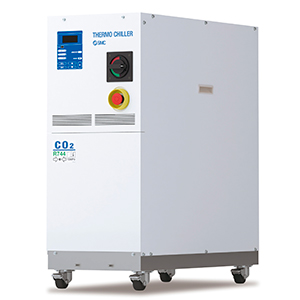
Non F-Gas (CO₂) thermo-chiller for the semiconductor industry. Precision-engineered for critical manufacturing processes. Cooling capacity up to 10 kW.
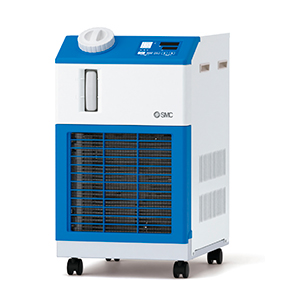
Non F-Gas (CO₂) thermo-chiller, standard type. Versatile cooling capacities from 1.3 to 11.5 kW for diverse industrial requirements.
SMC's innovative chillers featuring R454C refrigerant, designed to meet upcoming environmental regulations while delivering exceptional performance.
Standard type circulating fluid temperature controller. Cooling capacities from 1.1 to 20 kW.

Refrigerated thermo-chiller for critical semiconductor manufacturing processes. Cooling capacity up to 10 kW.
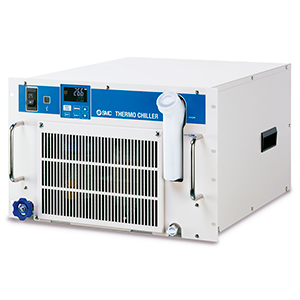
Rack mount type. Easy, space-saving installation — operable without removing the unit. Cooling capacity up to 1.8 kW.
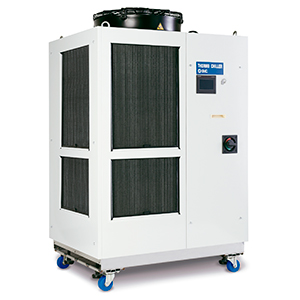
Dual channel thermo-chiller for lasers. Simultaneous control of two heat sources with a single device. Cooling capacity up to 20 kW.
Get some insights from our European Experts working daily on temperature control challenges.

Some customers ask why a company with its foundations in pneumatic equipment also offers thermo-chillers. The answer derives from an ethos that remains the basis for much of our success: the desire to help customers overcome their problems.
Read more
A practical look at how the F-Gas Regulation is reshaping refrigerant choice for industrial chillers, and what manufacturers should evaluate before their next equipment investment.
Read moreFree assessment · No obligation · Expert engineering review